
Can Doctors Access Anyone's Medical Records?

by Darby Marx and Andrew Parambath
Aug 07, 2024
In today’s digitized world of healthcare, it comes as a shock to many patients that doctors often cannot access their medical records from outside healthcare systems. Just the other day, we spoke with a patient who came in to follow up with their primary care doctor after an unexpected hospitalization from out of state. Curious about how much her primary team knew about her brief stay, she asked if we could automatically see the notes from her inpatient team. The answer came to her as a surprise: no, we could not. Thankfully her primary care doctor was able to get in touch with various clinicians by phone and get up-to-date information–but this took a great deal of time and effort. It certainly was not automatic.
Unfortunately, stories such as this are all too common for doctors. Missing clinical data is a significant issue across the United States, which lacks a unified electronic healthcare record (EHR) or system for sharing patient data. The resulting infrastructure is highly fragmented with the use of multiple EHRs that often lack interoperability and standardization.
This translates into the siloing of patient data in multiple places where clinicians, such as this patient’s primary care provider, might have to dig to find it, or might not be able to find it at all.
Compounded with increasing administrative duties and time restraints, lack of patient data accessibility is a contributor to provider burnout, which 48.2% of physicians suffered from in 2023. A doctor on average has only 3 minutes to review a patient’s chart before a visit. If they then do not have access to the appropriate patient data, they must spend extra time trying to figure out where to even look. Given that 49% of a doctor’s time is already spent in chart review and documentation, this issue only makes burnout worse.
Clinical Impact of Missing Patient Data
Beyond its contribution to burnout, lack of access to patient records across systems can adversely affect clinical care.
A JAMA study by Smith et al. found that primary care physicians endorsed missing clinical information during 13.6% of all visits. While they did report that the data was often located within the US, it simply was outside of their healthcare system. From a clinical perspective, clinicians reported that 44% of visits with missing clinical information were “at least somewhat likely to adversely affect patients” and 59.5% would “potentially result in delayed care or additional services.”
Further, it is critical to consider that vulnerable populations are more likely to seek care from multiple systems and as a result have missing data, such as immigrants and those with psychosocial issues and low socioeconomic status. Missing data also disproportionately affects new patients and those with multiple medical problems. Lack of clinical data for patients in these communities only increases the risk that they will not receive the care they need despite clinicians’ best efforts.
Health Information Exchanges (HIEs) & Accessibility
Health Information Exchanges (HIEs) can help address the issue of data accessibility. HIEs promote interoperability across different EHR systems in order to close the “missing health data” gap. These networks are compliant with HIPAA to ensure the security of health information, while also enabling the appropriate providers to gain access to patient data they may otherwise not see.
Not all HIEs are designed to work across all systems. While something is better than nothing, providers relying solely on HIEs such as Epic’s Care Everywhere network might find that their access to patient data is largely limited to its own ecosystem.
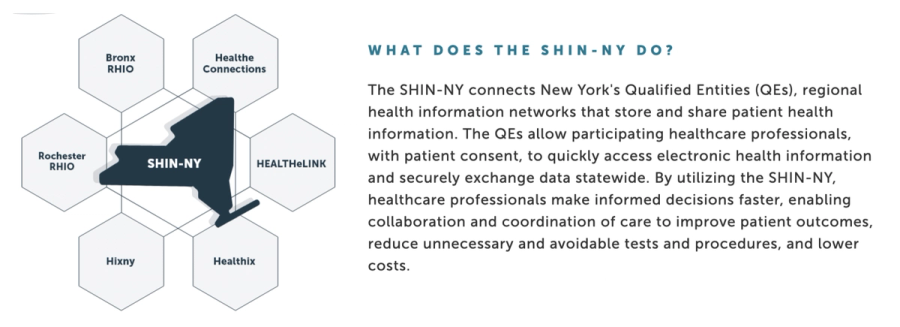
Other HIEs are more location-specific, designed to facilitate the sharing of patient data between providers within a certain region. Examples include New York’s SHIN-NY or California’s Cal INDEX. This too, as one might imagine, poses issues for providers caring for patients such as the one described above, who ended up in the hospital across the country.
Abstractive Health’s Comprehensive Solution
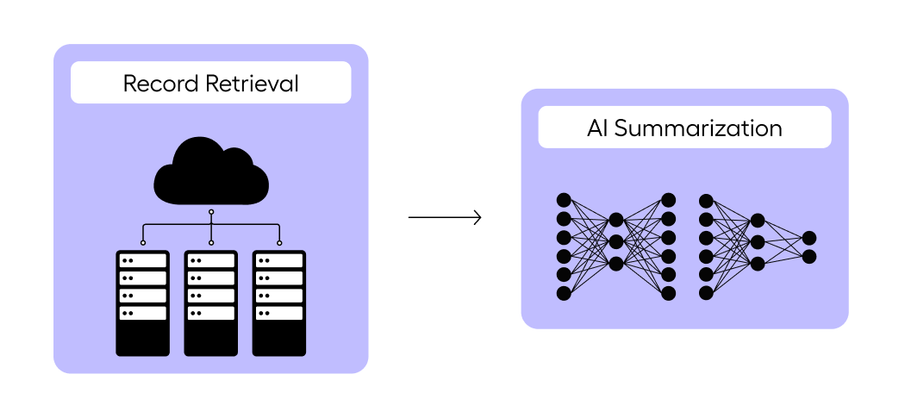
Abstractive Health, through a partnership with national HIE Carequality, hopes to directly address the issue of missing patient data as part of its larger mission to streamline the entire clinician’s workflow. With Abstractive Health’s technology, providers can quickly search for patients’ health information in healthcare systems across the entire country with basic info such as a patient’s name, date of birth, and gender. This is all possible because unlike more focused HIEs, Carequality is a national-level network that is not connected to one single EHR system, but to many.
But Abstractive Health can do much more than find missing patient data. Where they stand out is their ability to actually summarize clinical information. Leveraging an AI model that their team developed, their technology can summarize the entire medical record. If, for example, a patient search turns up dozens of clinical notes, their model will summarize them in a succinct note-like structure, which the provider can later edit themselves and save directly into the chart. Their method is highly accurate and clinically factual, with published research on their findings, a patent filed, and 3rd from over 200 companies by the VA as a leader in trustworthy AI for clinical summarization. Abstractive Health’s platform offers a variety of other features, including the ability to summarize handwritten notes and entire PDFs uploaded to the EHR.
Abstractive Health’s vision is that by combining both the ability to conduct comprehensive patient searches and accurately summarize the patient chart, they will help streamline the workflows of clinicians across the country. If you are interested, sign up for a free trial today to explore their search and summarization capabilities and much more!

See the Abstractive Health AI assistant in action to discover what real efficiency can look like.
Try for freeStay ahead of the curve in healthcare innovation.
Connect
Abstractive Health
Resources
©2026 Abstractive Health. All Rights Reserved.