
How to Read and Summarize Scan PDFs in Medical Records

by Andrew Parambath & Darby Marx
Aug 07, 2024
In the early days of healthcare, medical records were kept on paper. These records were meticulously handwritten, containing details about patient care, complications, and outcomes. Doctors and nurses would flip through thick folders, adding notes and test results, creating a tangible but cumbersome archive of a patient's medical history.
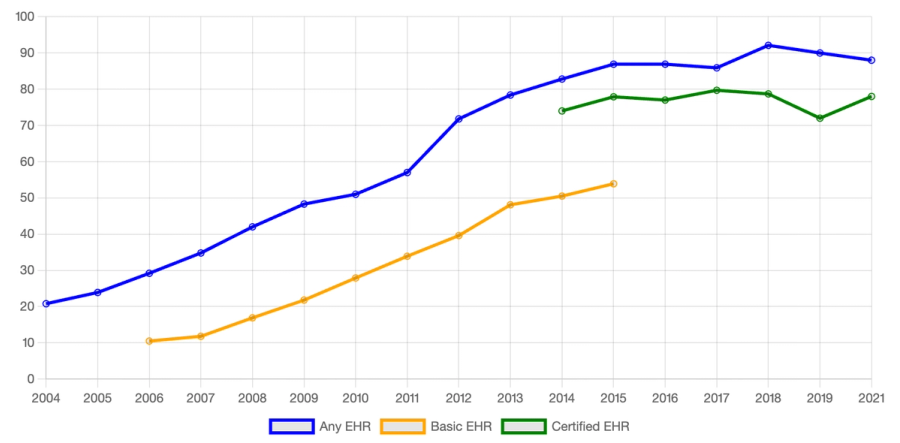
The 1980s and 90s saw a revolution in healthcare with the advent of computer technology. Forward-thinking departments like radiology and laboratory services began to adopt digital methods, and the movement toward electronic health records (EHRs) started to gain traction. However, it was not until 2009, with the Centers for Medicare and Medicaid Services (CMS) and the Office of the National Coordinator’s (ONC) mandate on meaningful use, that the shift from paper to digital records became widespread. Now over 90% of physicians use electronic health records (EHR). Healthcare dramatically transitioned from paper to digital format in a period of only 15 years!
Portable document format, or PDFs, became the staple in the transition to EHRs. Created by Adobe in the early 1990s, PDFs were designed to capture documents from any application making them easy to share and view on any machine. This format quickly became invaluable in healthcare, encapsulating a variety of information from text and images to links and form fields, all while maintaining the document's integrity and security.
The Data Overload of Medical PDFs
Today, PDFs are ubiquitous in medical records. They are used to store everything from imaging findings and lab results to operative reports and after-visit summaries. This digitization has undoubtedly enhanced accessibility and portability, allowing healthcare professionals to view patient records from anywhere. But with this shift comes a new challenge: the overwhelming volume of information contained in these digital documents.
A major complaint of physicians is the extraneous patient information in each medical chart. Excessive information, or “note bloat,” impairs comprehension and leads to potential errors. Often, providers will use templates as notes that automatically pull in data from other parts of the EHR that may not be relevant or even correct. This information gets passed down from note to note, leaving the chart full of notes containing this extraneous info.Studies show that physicians spend nearly twice as much time documenting in EHRs as they do interacting with patients. This not only frustrates physicians but may also compromise patient safety.
EHR systems falter when it comes to efficiently accessing data embedded in PDFs. Physicians are left to manually sift through pages and pages of text to find what they need. This includes critical imaging findings, lab values, and previous physician notes—information essential for patient management. For instance, biomarker results crucial for guiding targeted therapies are often shared via PDF reports and stored in the media tab of EHRs. These vital pieces of data are buried deep within unstructured document attachments, making retrieval a laborious task.
This inefficiency leads to repetitive lab tests and imaging scans, exposing patients to unnecessary radiation and delays. More concerning, it can compromise patient care by forcing physicians to spend more time discussing information that is already in the chart but difficult to locate. As a result, clinicians may not have the complete context for making informed medical decisions during patient visits. In the end, the goal of seamless, integrated patient care is hindered by the very systems designed to facilitate it.
Streamlining the Process with Digital Tools
Physicians require a PDF solution that minimizes the time spent searching for relevant patient information, allowing them to refocus on what truly matters: patient care. One such innovative tool is Abstractive Health.
Abstractive Health empowers physicians by allowing them to upload multiple PDFs and automatically summarize the pertinent medical information from each document. By filtering out extraneous details and highlighting essential points, Abstractive Health ensures that no critical information is overlooked. It transforms the chaotic jumble of digital paperwork into a coherent narrative, readily accessible at the physician's fingertips.
HOW THE PDF SUMMARIZATION TOOL WORKS
The Abstractive Health App, through a partnership with Reducto AI, uses object character recognition (OCR) to extract the text from the PDFs. The app captures the meta data in the scanned document such as tables, headers, handwritten text, and bolded characters; this metadata assists the summarization engine in understanding how to structure and select the most salient data. The Abstractive App then splits large documents into individual subsections to distinguish between different clinical encounters in a patient’s medical chart. The app is able to generate a comprehensive summary of the patient’s chart through weaving each clinical encounter of a patient’s chart history into a clinical story.
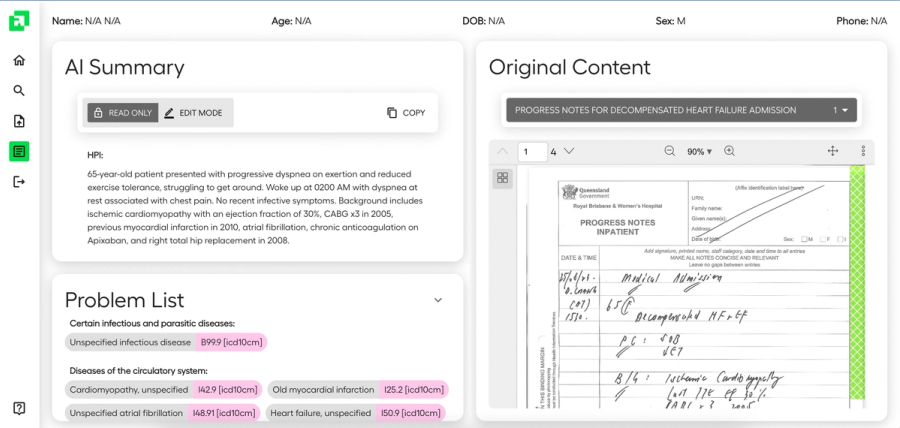
Abstractive Health redefines how clinicians interact with patient records. Instead of being bogged down by dense, unstructured data, physicians can swiftly access key insights, making informed decisions with remarkable efficiency. This streamlining of document management enhances both the productivity of healthcare professionals and the quality of patient care.
The broader landscape of healthcare is witnessing a surge in digital tools, each designed to address specific pain points. From AI-powered diagnostic algorithms to telemedicine platforms, the arsenal of technology available to clinicians is vast and ever-growing. Yet, the true test of these innovations lies in their ability to deliver value during the patient care process and be able to integrate seamlessly into the daily routines of healthcare providers. Abstractive Health's app aims to be innovative in not only the way its technology works, but also, and perhaps more importantly, in the efficiency and value it will provide clinicians in everyday clinical practice.

See the Abstractive Health AI assistant in action to discover what real efficiency can look like.
Try for freeStay ahead of the curve in healthcare innovation.
Connect
Abstractive Health
Resources
©2026 Abstractive Health. All Rights Reserved.