
Best tools for Medical Record Summarization in 2026

by Andrew Parambath, MD, MBA
Jan 06, 2026
Chances are, if you’re reading this, you have a medical record, and for many patients, that record is far larger than they realize. A single individual receiving routine and specialty care over several years can accumulate hundreds to thousands of pages of notes, consults, imaging reports, operative summaries, scanned faxes, and referral documents. In large health systems, it’s common for complex patients to have 5–10+ years of longitudinal documentation, often spread across multiple practices and EHRs.
Clinicians know the feeling: walking into a room bracing for a fragmented history, only to be met by a caregiver, parent, or loved one who brings the entire story into focus. It might be the mother of a child with intellectual disability who remembers every hospitalization, every medication trial, every subtle change no record ever captured. Or the daughter of an elderly, nonverbal parent who quietly hands you the most accurate, complete history you’ve heard all week. In these moments, rare as they are, the room shifts. The noise falls away. The visit becomes easier, safer, more humane.
These “gold-standard historians” give clinicians what they wish they had for every patient: a succinct, trustworthy, clinically relevant account of who this person is and what has happened to them over time.
Most people assume this challenge mainly affects frontline clinicians preparing for a visit, but the reality is far broader. Researchers must parse multi-year histories to analyze cohorts for observational studies, outcomes evaluation, and the development of real-world evidence. Insurers and utilization-management teams review entire charts to assess medical necessity, verify prior-authorization criteria, and adjudicate claims under tight timelines. Legal and compliance teams often analyze decades of documentation for audits, disability evaluations, malpractice reviews, and litigation. Care-management and population-health teams also depend on accurate historical context to stratify risk, coordinate care, and prevent avoidable hospitalizations. In short, the challenge of making sense of large, unstructured medical records spans the entire healthcare ecosystem not just in clinical care.
Across all of these contexts, the volume of medical records has exploded, U.S. hospitals now exchange over 1.2 billion clinical documents annually, and the average chart pulled through national interoperability networks contains 70–250 pages per request, often more for high-risk patients (Carequality). The result is a universal bottleneck: massive amounts of clinical data, but limited time and capacity for humans to interpret it.
AI summarization tools aim to close that gap by synthesizing multi-year, multi-source charts into clear, structured outputs tailored to the needs of the end user, whether that’s a frontline clinician preparing for a visit, a care manager assessing eligibility, or a researcher extracting longitudinal context.
This article outlines a practical framework for evaluating summarization tools, followed by an overview of widely used solutions entering 2026. Because these platforms serve very different customer segments, the goal is to clarify each tool’s core purpose and where it fits best within the broader ecosystem.
How to Evaluate Medical Record Summarization Tools
While there are many ways to evaluate medical record summarization, we propose a framework that is not exhaustive but provides a structured lens for evaluating these tools. Every organization will prioritize features differently, yet most requirements fall into recognizable categories. The following framework is one practitioners can apply when assessing most summarization tools.
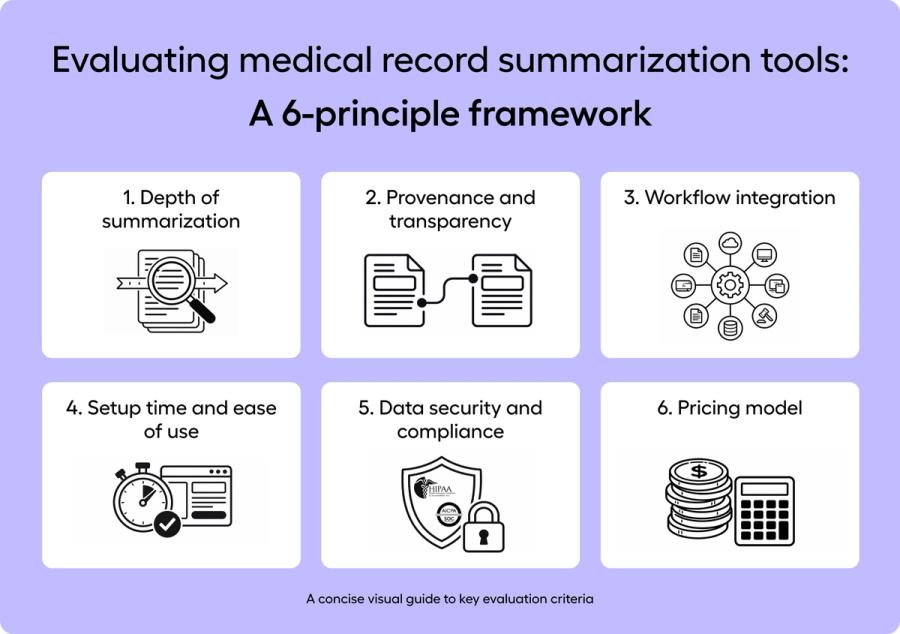
1. Depth of Summarization
One of the most important dimensions is how deeply a tool can understand and condense a patient’s medical history. Some systems are designed to summarize single encounters, while others can handle multi-visit episodes or full longitudinal histories spanning many years. The complexity of the underlying data—oncology, cardiology, transplant, psychiatry, multisystem chronic disease—also determines whether a tool can accurately capture nuance rather than oversimplify the clinical picture.
A related but often overlooked factor is the technical capacity of the underlying model. Medical records frequently contain tens of thousands of words, and some multi-year charts exceed the equivalent of hundreds of thousands of tokens. Effective summarization therefore depends on how much text a system can reliably ingest and how much detail it can safely return. Different tools have varying limits on input size, token windows, chunking strategies, and maximum output length, which directly affect their ability to preserve clinical nuance, maintain chronology, and produce coherent longitudinal summaries. Systems with narrower context windows may summarize record fragments in isolation, which can miss key temporal relationships or introduce inconsistencies.
Teams should therefore evaluate not just what the tool attempts to summarize, but whether the model’s input/output architecture can support the depth required for real-world medical records.
Questions to ask:
- Does the tool summarize single visits, multi-episode timelines, or complete multi-year histories?
- Can it handle specialty-level complexity?
- Does it produce narrative summaries, structured outlines, or claims-grade chronological histories?
- Can the system process entire multi-year charts at once, or does it rely on chunking the record into smaller sections that may lose context?
- Does the tool allow control over output length and detail—such as high-level overviews, problem-specific summaries, or full granular timelines?
2. Provenance and Transparency
Teams must also be able to trust the output, and trust requires visibility into where each statement comes from. Strong summarization systems provide clear traceability back to the source document, allowing users to quickly verify critical details. This verification burden is not trivial: in many specialties, clinicians spend 7–8 hours of EHR time for every full clinical day, including extensive chart review. Infectious disease, endocrinology, nephrology, primary care, and hematology are among the highest-burden specialties, each averaging over seven hours of EHR work per clinic day. This is also extended outside of the clinical context such as in areas of insurance and legal contexts. When information cannot be traced back to its origin, this burden only increases. Tools that operate as opaque “black boxes” risk undermining confidence, especially in high-stakes workflows where accuracy and defensibility are essential.
Questions to ask:
- Does each statement link back to the original note or page?
- How quickly can a reviewer verify the source?
- Does the system surface evidence or citations to support key claims?
3. Workflow Integration
Summarization tools are only effective if they fit naturally into the environments where they are used. In clinical settings, seamless integration might mean SMART-on-FHIR apps, browser extensions, in-EHR summaries, or automatic ingestion of HIE records. But many high-volume workflows operate outside of traditional clinical care, and their integration requirements differ substantially.
In insurance and utilization-management, teams often work from uploaded PDFs, inbound faxes, or claims packets, making bulk upload portals, case-management system integrations, and automated ingestion pipelines essential. In legal and medical-legal settings, tools must integrate with document repositories, e-discovery platforms, deposition workflows, and audit trails, where defensibility and precise source referencing matter more than EHR connectivity.
Because each environment has its own constraints and data flows, the “right” integration model varies widely. Summarization tools should align with the systems, file formats, and processes already in place and not require teams to redesign how they work.
Questions teams can ask:
- Does the tool integrate with the EHR, HIE networks, or other internal systems?
- Can the tool ingest, parse and summarize a diversity of file formats, including structured and unstructured data?
- Does it require manual uploads?
- Is it optimized for the specific workflow we are trying to improve?
- Can the tool maintain document structure so that summaries align with how teams already work?
4. Setup Time and Ease of Use
Adoption often hinges on how quickly users can get value from the system. Some tools require minimal setup and can be used immediately, which is especially important in environments outside of healthcare, such as insurance, legal review, or claims adjudication, where teams may not have IT support or the ability to change system configurations. Other tools require deeper integration, custom configuration, or multi-week implementation before they are usable. Ease of use is equally critical: if a clinician, reviewer, attorney, or adjuster cannot operate the tool within minutes, it will not be used consistently.
Questions teams can ask:
- Can users get started quickly without IT involvement?
- Does the tool blend into existing workflows, or does it add steps or complexity?
- How much training is required for non-technical users, including insurance teams, legal reviewers, and claims analysts?
5. Data Security and Compliance
Medical summarization tools must meet security standards appropriate to the environment in which they operate. In healthcare settings, tools generally need to comply with HIPAA, the U.S. law governing how patient health information must be stored, transmitted, and protected (HIPAA). Insurers, legal teams, and research organizations often require SOC 2 Type II, an independent audit that confirms a company has strong, consistently applied controls for keeping sensitive data secure (Vanta). Some organizations also look for HITRUST, a certification that adds an additional layer of rigor and is considered one of the more comprehensive security frameworks in the industry (HITRUST). High-risk workflows, such as utilization management, claims review, or litigation may also require detailed audit logs and strict access controls so that every data action can be tracked and defended. Importantly, most of these security assurances should be publicly visible on the company’s website or verifiable through third-party auditors, allowing buyers to confirm that a vendor’s claims are legitimate. The sensitivity of the use case typically determines how stringent these requirements must be.
Questions teams can ask:
- Does the product meet required certifications such as HIPAA, SOC 2, or HITRUST?
- Are audit logs and access controls available?
- Can the vendor’s security claims be verified through independent auditors or public documentation?
- Is the system suitable for high-risk contexts such as claims review or litigation?
- Is the system suitable for high-risk contexts such as claims review or litigation?
6. Pricing Model
Finally, organizations need clarity on how pricing scales with usage. Summarization vendors vary widely in how they charge: some price per clinician, others per chart or per case, and some meter usage by document volume. Many also include implementation or onboarding fees that meaningfully affect total cost, and buyers should be wary of hidden costs such as overage charges, page-count tiers, or fees for large multi-year uploads. “Unlimited” plans can still include caps or fair-use limits, and pricing may differ across departments—clinicians, care managers, claims teams, and legal reviewers are not always priced the same. Larger organizations should also ask whether enterprise discounts or bundled pricing are available, as these can materially shift long-term cost.
Questions teams can ask:
- Is pricing based on users, charts, cases, or document volume?
- Are charts truly unlimited, and are there caps or fair-use limits?
- Are there implementation or onboarding fees?
- Are there overages or hidden costs tied to page count or volume?
- Does pricing vary across departments?
- Are enterprise discounts available?
With this framework in mind, the following section outlines several of the leading companies offering medical-record summarization. These tools differ widely in depth, traceability, workflow fit, implementation burden, security posture, and pricing structure. We hope to highlight what each solution is designed for and where it tends to perform best, allowing organizations to map the earlier criteria to their specific needs.
Medical Record Summarization Tools
A full list of other clinical AI summary companies can be found at Elion! We have selected a handful to highlight below:
Tool: Abstractive Health
- Primary Use Case: Clinical chart prep; longitudinal patient context; physician-centric interface.
- Summary Depth: Multi-year, multi-specialty longitudinal summaries with capabilities to query the chart for answers substantiated by patient data and medical evidence.
- Provenance / Transparency: Sentence-level provenance where every statement links back to the original source document.
- Integration & Workflow: Standalone app; HIE retrieval; SMART-on-FHIR EHR integration; proprietary API; support for upload and ingest of PDFs, handwritten notes, faxes, and CCDs via UI and API.
- Setup Time: Minutes - Days.
- Pricing (Approx.): $99/provider/mo (unlimited charts).
- Best Fit: Practicing physicians in need of full-chart, high-transparency, narrative summaries of their patients. Clinical teams looking to improve patient intake, care coordination, HEDIS reporting, and quality of documentation for high impact conditions like CHF, diabetes and sepsis.

Tool: Apex Medical AI
Primary Use Case: Specialty clinics; referral intake; inbound records, patient registry.
Summary Depth: Specialty-focused structured summaries.
Provenance / Transparency: Structured output (no sentence-level provenance).
Integration & Workflow: Fax/eFax ingestion, EHR workflows, doc automation.
Setup Time: Days.
Pricing (Approx.): ~$1,900/provider/mo.
Best Fit: High-volume specialty practices with heavy external records.
Tool: Autonomize AI
- Primary Use Case: Prior auth review, care-management, HEDIS/quality abstraction, insurance document review.
- Summary Depth: Multi-document summaries across clinical notes, labs, imaging, UM packets.
- Provenance / Transparency: Structured outputs; emphasis on decision support and reducing reviewer error.
- Integration & Workflow: Upload-based portal; integrates into payer and care-management workflows (non-EHR focused).
- Setup Time: Not disclosed.
- Pricing (Approx.): Not disclosed.
- Best Fit: Payers and care-management teams automating prior auth, UM, and quality review.
Tool: DigitalOwl
Primary Use Case: Insurance, underwriting, medical-legal, claims review.
Summary Depth: Claims-grade chronologies, timelines, case insights.
Provenance / Transparency: Click-to-evidence linking to specific pages.
Integration & Workflow: Self-serve portal + enterprise integrations.
Setup Time: Days.
Pricing (Approx.): $2000/provider/month but low as $99/month for 2-5 medical records (includes 1,000 pages/month with $0.50 per additional page)
Best Fit: Legal/insurance teams needing defensible medical chronologies.
Tool: Emtelligent
Primary Use Case: Enterprise-grade clinical data extraction, AI-assisted chart review, prior-auth automation, quality/STARs/HEDIS abstraction, trial screening, real-world evidence generation, and bulk medical document processing.
Summary Depth: Extracts structured clinical entities, relations, biomarkers, scores, inclusion/exclusion criteria, plus configurable patient summaries.
Provenance / Transparency: Complete document traceability, ontology-aligned outputs and auditable field-level evidence.
Integration & Workflow: Highly flexible with deployable APIs, private cloud, customer cloud, or as embedded modules inside payer, health system, or tech-platform workflows.
Setup Time: Turnkey 30-day implementation path (demo → data prep → validation → production).
Pricing (Approx.): Enterprise licensing (volume- and workflow-based). No public pricing.
Best Fit: Large payers, pharma/clinical research teams, health systems, and health-tech/data platforms..
Tool: Fourier
- Primary Use Case: AI-driven medical record ingestion, triage, data reduction, and specialty-focused chart summaries for referrals, consults, and new-patient onboarding.
- Summary Depth: Extracts key findings, organizes documents, labels and triages records, and produces concise specialist-ready summaries.
- Provenance / Transparency: Clinician-in-the-loop QA, one-click verification, direct citations to source documentation, transparent lineage, and anti-hallucination safeguards.
- Integration & Workflow: RRobust as it integrates with EHRs using SMART on FHIR, HL7 v2, and bidirectional FHIR APIs.
- Setup Time: With plug-in via SMART on FHIR or HL7; works with existing ambient and document workflows.
- Pricing (Approx.): Not publicly disclosed; enterprise pricing based on document volume and workflow modules.
- Best Fit: Clinician groups, referral management teams, and health systems who need fast triage, document labeling, and specialist-ready summaries.
Tool: HealthKey
Primary Use Case: Fast clinical chart prep; research; trial matching.
Summary Depth: Single-episode + cross-visit structured outlines.
Provenance / Transparency: Structured summary; not full provenance.
Integration & Workflow: Upload portal, batch processing; trial criteria matching.
Setup Time: Days.
Pricing (Approx.): ~$249/provider/mo.
Best Fit: Research teams, trial sites, clinicians needing fast chart prep.
Tool: Layer Health
- Primary Use Case: Automated clinical registry abstraction, pathway data extraction, and evidence-grounded structured chart review.
- Summary Depth: Registry-ready structured fields, condition-specific modules, and narrative clinical context derived from multi-note records.
- Provenance / Transparency: Every extracted field is linked to specific EHR evidence (note excerpts, labs, imaging).
- Integration & Workflow: API or EHR-integrated modules; also supports standalone abstraction workflows for registries.
- Setup Time: Deployable as plug-and-play modules for major registries; deeper EHR integration requires IT coordination.
- Pricing (Approx.): Not publicly disclosed; enterprise pricing for health systems and large service lines.
- Best Fit: Health systems, quality teams, or service lines needing high-volume, high-accuracy registry abstraction.
Tool: Regard
Primary Use Case: In-EHR summarization + diagnostic insights.
Summary Depth: EHR-native summaries + AI reasoning.
Provenance / Transparency: Embedded EHR output; audit trails.
Integration & Workflow: Deep EHR integration (Epic, inpatient focus).
Setup Time: Weeks.
Pricing (Approx.): $500/month/user with Enterprise pricing (high hundreds per user).
Best Fit: Hospitals with IT resources; inpatient teams.
Tool: Sky AI
Primary Use Case: Legal/IME rapid summaries and timelines, fraud/red flag detection.
Summary Depth: Fast, lightweight summaries & chronologies.
Provenance / Transparency: Summary-level transparency; source review optional.
Integration & Workflow: Upload-based portal; API.
Setup Time: Minutes.
Pricing (Approx.): ~$600/user/mo + usage.
Best Fit: Firms wanting speed + low overhead.
Tool: Wisedocs
Primary Use Case: Insurance, IME, mass tort, claims operations.
Summary Depth: Claims-grade, structured, human-audited summaries.
Provenance / Transparency: Page-linked source context for each summary point.
Integration & Workflow: Upload portal; workflow system for large teams.
Setup Time: Days–weeks.
Pricing (Approx.): $2400/month.
Best Fit: High-volume IME/claims orgs needing auditability.
Final Thoughts
Medical-record summarization sits at an inflection point. The tools reviewed here represent the first generation of systems capable of transforming multi-year, multi-source clinical histories into reliable, structured, and traceable insights. While today’s products vary widely in depth, transparency, workflow fit, and cost, their trajectories are clear: richer longitudinal understanding, tighter provenance controls, and seamless embedding within clinical, payer, and legal workflows.
As healthcare shifts further toward value-based and risk-bearing models, summarization is also becoming a source of competitive advantage. Organizations operating in payer-adjacent domains—accountable care organizations, Medicare Advantage practices, and home-visit HCC capture programs—rely on longitudinal context to drive accurate risk adjustment, reimbursement, and performance under value-based contracts.
The next frontier is summarization that moves beyond description to actively support clinical reasoning, triage, eligibility determination, and care coordination, always with safety, transparency, and oversight at the center. Organizations that evaluate their options with a structured framework will be able to adopt these technologies responsibly, improve operational efficiency, and ultimately free human experts to focus on the highest-value decisions. Summarization is no longer a convenience; it is becoming core infrastructure for a data-heavy healthcare system.
Related Articles

See the Abstractive Health AI assistant in action to discover what real efficiency can look like.
Try for freeStay ahead of the curve in healthcare innovation.
Connect
Abstractive Health
Resources
©2026 Abstractive Health. All Rights Reserved.